

Rehab cost with insurance usually looks very different from the scary sticker price families see online. If you have a PPO plan, treatment is often at least partly covered, but what you actually pay depends on a few moving parts: your deductible, your network, the level of care approved, and how your insurer reviews the stay. Good news, this is more understandable than it sounds, and once you know the cost drivers, comparing options gets much easier.
What rehab cost with insurance usually means for PPO members
For most PPO members, “rehab cost with insurance” means this: the treatment center has a list price, your insurer applies its own rules and contracted rates, and you pay only your share of covered services. That share might be modest, or it might still be significant. The difference often comes down to network status and plan design.
The reassuring part is that substance use treatment is commonly covered. In fact, for most people, health insurance will at least partially cover detox programs and drug or alcohol rehab because these services are classified as essential medical services. That does not mean every center is covered equally, and it definitely does not mean every stay is fully paid for. But it does mean many people are not starting from zero.
Think of PPO coverage like a discount system with rules. The treatment center may charge one number, but your insurer has a separate allowed amount, then your deductible, coinsurance, and any approvals shape the final bill. Two people can enter similar programs and leave with very different out-of-pocket costs.
That’s why the right question is not “Does insurance cover rehab?” It’s “How much of this specific rehab stay will my PPO cover, at this facility, for this level of care?”
Why PPO plans can lower rehab costs, but not make rehab free
A PPO, or Preferred Provider Organization plan, usually gives you more flexibility than an HMO. You can often choose from a larger network, and many PPOs include some out-of-network benefits too. That flexibility matters if you want privacy, a specialized program, or treatment in another state.
But “covered” and “free” are not the same thing.
You still pay a monthly premium to keep the plan active. Then, when treatment starts, you may need to meet a deductible before the insurer pays much at all. After that, you may owe a copay or coinsurance. If the facility is out of network, your share often rises sharply. And if some services are not covered, those costs may not count toward your out-of-pocket maximum.
Here’s the part many families miss: PPO insurance usually covers more of the cost of rehab when a patient uses an in-network provider; if the rehab center is out of network, the patient will typically pay more out of pocket for treatment. So yes, PPOs can lower the cost substantially. No, they do not erase it.
That is why a benefit check matters so much. If you want a broader look at how private plans handle addiction treatment, it helps to read more about what PPO plans usually pay for treatment before comparing facilities.
The cost terms you need to know before you compare centers
Insurance language gets confusing fast, especially when you are already stressed. So here are the practical definitions that matter most.
A deductible is the amount you pay each plan year before insurance starts sharing more of the cost. If your deductible is $3,000 and you have only met $500 so far, you may still owe the next $2,500 of covered treatment costs before the plan pays at the higher rate.
A copay is a flat fee, such as $30 for a visit. Copays are more common in outpatient settings than in residential rehab.
Coinsurance is your percentage of the bill after the deductible. If your plan pays 80 percent in network, your coinsurance is 20 percent.
An out-of-pocket maximum is the cap on what you pay for covered in-network services during the plan year. Once you hit it, the insurer usually pays 100 percent of covered in-network charges for the rest of that year. Good news, this is often the number that matters most in a bigger treatment episode.
In-network means the rehab center has a contract with your insurer and agreed rates. Out-of-network means no contract, which usually brings higher costs and more uncertainty.
Prior authorization means the insurer wants approval before certain services begin. Without it, a claim can be denied even if the treatment itself would otherwise qualify.

What types of rehab your PPO may cover
Most PPO plans cover more than one level of addiction treatment. The insurer usually looks at medical necessity, meaning the care has to match the severity of symptoms, withdrawal risk, relapse history, and mental health needs. Personal preference matters, but it is rarely enough by itself.
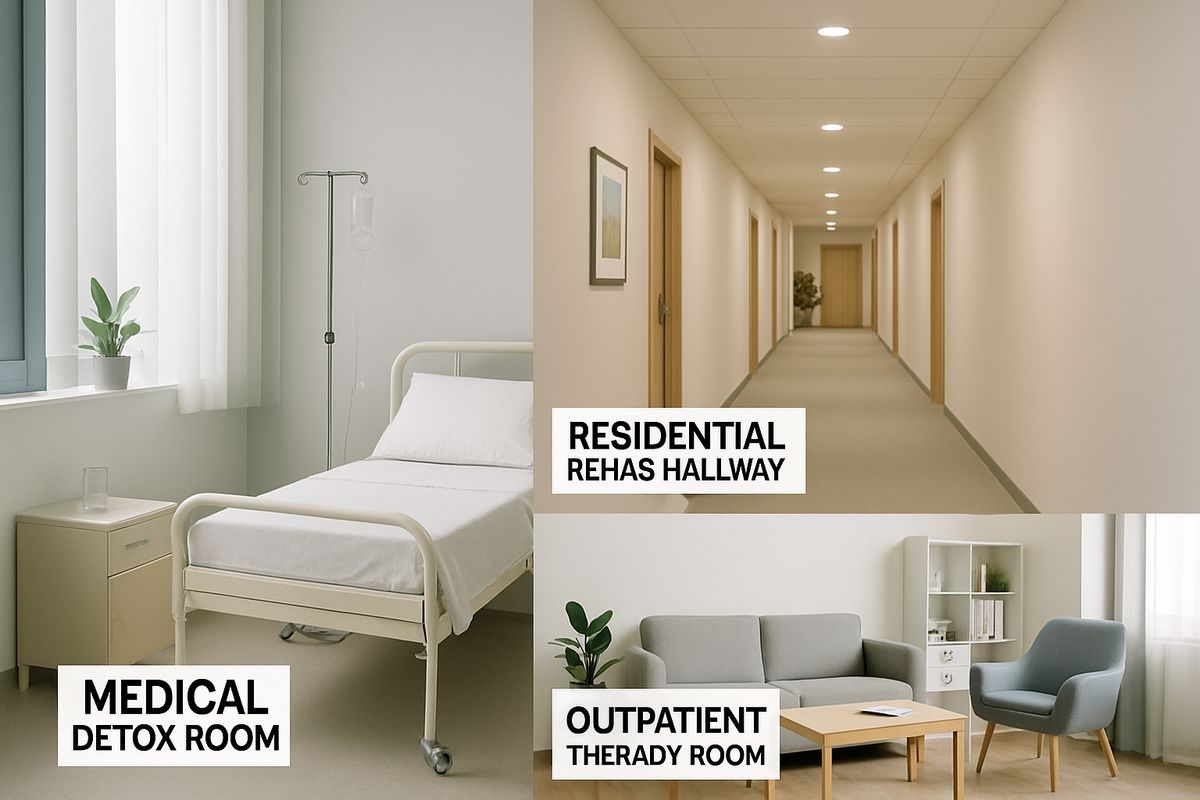
Broadly, insurance may cover medically supervised detox, inpatient rehab, outpatient rehab, high-intensity outpatient programs (PHPs), intensive outpatient programs (IOPs), and aftercare. The exact mix depends on your policy and the clinical recommendation.
Detox
Detox is the medically supervised phase where substances leave the body and withdrawal symptoms are managed safely. This level of care is often covered when withdrawal risks are serious enough to require monitoring, medication, or nursing support.
Before insurance, medical detox typically costs $500 to $1,500 per day. The final patient cost depends on how many days are approved, whether the facility is in network, and whether medications, labs, and physician visits are bundled or billed separately.
Many people assume detox is optional if they want to save money. That can backfire. If someone is at risk for alcohol, benzodiazepine, or opioid withdrawal complications, skipping detox can create a medical emergency and a much bigger bill later. If you want a closer look at this level of care, it helps to review how coverage for supervised withdrawal is often handled.
Inpatient or residential rehab
Residential treatment means you live at the facility and receive 24/7 support. This usually includes therapy, group counseling, case management, meals, housing, and recovery planning in one bundled setting.
Before insurance, residential treatment costs about $10,000 to $30,000 per month. That wide range reflects staffing, location, amenities, length of stay, and clinical intensity.
Insurers often watch residential stays closely. They may approve a short block of days first, then continue coverage only if the clinical record supports it. So even when residential rehab is covered, the full month is not always approved all at once.
Partial hospitalization program (PHP)
PHP is a structured day program that offers many hours of treatment each week without overnight housing. It can work well for people who need strong support but are stable enough not to require 24/7 residential care.
Before insurance, PHPs cost $5,000 to $15,000 per month. In many cases, PHP costs less than residential treatment because room and board are not included.
This level is often used as a step-down from detox or residential care, though some people start here directly if clinically appropriate.
Intensive outpatient program (IOP) and standard outpatient care
IOP gives you several treatment sessions each week, often in morning or evening blocks, so people can keep some work, school, or family responsibilities in place. Standard outpatient care is less intensive and may include individual therapy, medication management, and recovery check-ins.
Before insurance, IOP usually costs $3,000 to $10,000 for a full course of treatment. Outpatient therapy can cost even less, especially after the deductible is met.
These lower levels of care are often approved for longer periods than residential treatment. They can also be more financially manageable, though only if the person is actually safe and stable enough for that setting.
What your actual out-of-pocket rehab cost depends on
This is where the real math starts. Your PPO may say it covers addiction treatment, but your final bill still depends on several cost levers working together.
In-network vs. out-of-network care
For most families, this is the single biggest price factor. In-network rehab usually produces lower out-of-pocket costs because insurance plans apply negotiated rates, and those charges count toward the in-network out-of-pocket maximum.
Out-of-network care can still be covered under many PPOs, but the catch is the plan may reimburse based on a lower “usual and customary” rate rather than the facility’s full charge. That leaves you with a larger deductible, a higher coinsurance share, and sometimes balance billing. In plain English, the center can bill you for the difference between what it charges and what the insurer allows.
That is why the “best” rehab on paper may not be the best financial fit.
Medical necessity and level-of-care approval
Insurers usually do not approve treatment just because a person wants it. They approve the level of care that appears medically justified based on symptoms, substance use severity, relapse risk, withdrawal risk, mental health concerns, and functioning at home or work.
This can feel frustrating, especially when a family wants residential treatment for safety and privacy. But the insurer may say PHP or IOP is enough. Clinical need should drive the decision, yet insurance review often shapes what becomes realistically available.
Prior authorization and concurrent review
Prior authorization is the insurer’s pre-approval process. Concurrent review is the check-in that happens during treatment to decide whether more days are covered.
This matters a lot because higher levels of rehab care, including residential treatment, PHP, and IOP, almost always require prior authorization and concurrent review, and failure to obtain or extend authorizations is one of the most common preventable causes of denial. In practice, that means a center may get approval for a few detox days or one week of residential care first, then submit updates to justify more time.
A strong admissions and utilization review team can make a real difference here. Not by gaming the system, but by documenting symptoms clearly and keeping approvals current.
Your deductible, coinsurance, and out-of-pocket maximum
Timing matters more than many people realize. If it is late in the year and you have already met most of your deductible through other medical care, rehab may cost much less than expected. If it is January and you are starting from zero, the first part of treatment may be more expensive.
Here is a simple example. Say your in-network deductible is $2,500, your coinsurance is 20 percent after that, and your out-of-pocket maximum is $6,000. If covered treatment totals $18,000 at negotiated rates, you might pay the first $2,500, then 20 percent of the remaining covered amount until you hit that $6,000 cap. After that, covered in-network services are usually paid in full for the rest of the plan year.
That one number, the out-of-pocket maximum, can help you plan. It is also one reason verifying benefits early matters so much. For a broader budgeting picture, many families also compare real treatment price ranges for 2026 before deciding where to call.
How much rehab may cost with PPO insurance at each level of care
No article can give your exact bill. Contracts, state rules, medical reviews, and plan design vary too much. Still, examples help.
Example: what detox may cost after insurance
Imagine a detox stay billed at $1,000 per day for five days. The list price is $5,000.
If the facility is in network, the insurer’s allowed amount might be lower than the list price. Suppose the allowed total is $4,000. If you still owe $1,500 on your deductible, you pay that first. Then if your coinsurance is 20 percent, you would owe 20 percent of the remaining $2,500, which is $500. Your total out-of-pocket cost would be about $2,000.
If your deductible was already met, the same stay might cost only the 20 percent coinsurance, or about $800 on a $4,000 allowed amount.
That’s a big difference.
Example: what residential rehab may cost after insurance
Now imagine a 30-day residential stay with a list price of $24,000. At an in-network facility, the negotiated rate might be lower, though the exact number varies widely.
Let’s say the allowed amount comes to $18,000. If you have already met your deductible and your coinsurance is 20 percent, your share might be around $3,600, unless you hit your out-of-pocket maximum sooner. If your maximum is $5,000 and you have already spent $2,000 on other care earlier in the year, your remaining liability may stop at $3,000.
Now compare that with an out-of-network center. The same facility may charge $24,000, while your insurer recognizes only $14,000 as the usual and customary amount. If the plan pays 60 percent after a separate out-of-network deductible, you could owe the deductible, 40 percent of the allowed amount, and the unpaid balance above the insurer’s allowed rate. Suddenly, the bill may jump into five figures.
That is why out-of-network care can be financially manageable for some families, but surprisingly expensive for others. It has to be modeled carefully.
Example: what PHP or IOP may cost after insurance
PHP and IOP often look more approachable financially, especially after residential treatment or for people who do not need 24/7 support.
Say a month of PHP has a list price of $8,000, but the in-network allowed amount is $6,000. If your deductible is met and your coinsurance is 20 percent, your cost may land around $1,200.
For IOP, imagine a full course priced at $4,500, with an allowed amount of $3,600. At 20 percent coinsurance, your share might be roughly $720.
These examples are not promises, but they show the pattern. Step-down care often lowers both the total bill and the patient share. More importantly, it can keep treatment going long enough to support recovery, which is usually cheaper than repeated relapse cycles.

What federal rules do, and do not, require PPO plans to cover
Federal law gives people more protection here than many realize. But those protections have limits.
Broadly, the Mental Health Parity and Addiction Equity Act of 2008 and the Affordable Care Act of 2010 require most health plans to provide meaningful coverage for substance use disorder treatment, including medical detox, residential treatment, PHP, IOP, and outpatient services. That is a strong foundation.
It does not mean every PPO plan covers every center, every day, or every luxury feature.
ACA protections that help people seeking addiction treatment
The ACA changed the insurance landscape in a practical way for people seeking rehab. Marketplace health plans are required to cover psychotherapy, counseling, inpatient mental and behavioral health services, and treatment for substance use disorders. Those benefits are part of why rehab is often more accessible now than it was years ago.
Just as important, Marketplace plans cannot deny coverage or charge more because of pre-existing conditions, including substance use disorders or mental health struggles, and they cannot place yearly or lifetime caps on essential health benefits such as substance use disorder treatment. That protection matters for anyone who has delayed treatment out of fear that their history will be used against them.
Why coverage can still vary even with parity laws
Parity laws aim to stop insurers from treating behavioral health more harshly than medical care. But parity does not force every plan to use the same network, the same reimbursement rates, or the same review process.
So one PPO may cover a broad set of residential providers, while another has a narrow network and tougher authorization standards. One plan may have a $1,000 deductible, another a $7,500 deductible. One may include meaningful out-of-network benefits, another may technically include them but reimburse so little that the option is not realistic.
That is why legal protections help, but benefit verification still does the real work.
Hidden costs families often miss when budgeting for rehab
Quoted treatment tuition is only part of the picture. The total financial commitment can be higher than expected, especially if the family is traveling for care or trying to protect privacy.
Travel, medications, and medical visits
If you are looking outside your home area for discretion or higher-quality care, travel costs add up quickly. Flights, gas, hotel stays for family visits, and airport transfers may not be part of the treatment quote.
Then there are the medical extras. Prescription medications, psychiatric evaluations, lab work, follow-up doctor visits, and aftercare appointments may be billed separately depending on the center and the plan. Some are covered well. Some are not. Always ask.
Time away from work, childcare, and family support
For working adults, the biggest non-medical cost may be lost income or reduced work capacity. Even if someone uses paid leave, time away from clients, projects, or business operations can affect the household budget.
Families also run into childcare costs, eldercare support, pet boarding, and transportation changes. None of that shows up in the insurance explanation of benefits, but it absolutely affects affordability.
Balance bills and non-covered services
Balance billing is the classic surprise. It happens most often with out-of-network care, but it can also show up when outside physicians, labs, or specialists are not contracted the same way as the facility.
Private rooms, luxury amenities, special dietary services, recovery coaching, and some elective add-ons may not be covered at all. Good news, this is avoidable if you ask for a written estimate that separates covered treatment from optional extras.
How to verify your PPO rehab benefits before you commit
The fastest way to reduce financial uncertainty is to verify benefits before admission, not after. Insurance verification should be completed before entering rehab because it identifies covered levels of care, prior authorization requirements, deductible status, copay or coinsurance amounts, out-of-pocket maximums, and whether the facility is in-network or out-of-network.
This step is worth slowing down for, even if admission feels urgent.
Questions to ask your insurer
When you call member services, keep your insurance card in front of you and write everything down. The goal is not just to ask “Do you cover rehab?” The goal is to pin down exactly how.
Ask whether the center is in network. Ask whether you have out-of-network benefits, and if so, what the deductible and coinsurance are for those services. Ask whether prior authorization is required for detox, residential rehab, PHP, and IOP. Ask how much of your deductible has already been met this year, what your out-of-pocket maximum is, and how much remains.
Also ask whether there are day limits, visit limits, or medical-necessity criteria that commonly affect approval. If the representative gives you reference numbers for the call, save them.
Questions to ask the rehab center’s admissions or billing team
The center should be able to run a benefits verification and explain what they found in plain English. Ask whether they will verify benefits before admission, whether they handle prior authorizations and concurrent reviews, and whether they can provide an estimate of patient responsibility in writing.
Ask whether they pursue single-case agreements if the center is out of network. Ask what happens financially if the insurer approves fewer days than expected. Ask about deposits, payment plans, refund policies, and what services are billed separately.
A good admissions team does not just talk about healing. They also explain the money clearly. In fact, verifying insurance benefits before starting treatment helps patients know their coverage limits and estimated out-of-pocket costs in advance, rather than finding out after admission.

If your PPO coverage is limited, what payment options may help
Sometimes the benefit check comes back and the numbers still feel heavy. That does not always mean treatment is out of reach. It means you need a payment strategy.
Payment plans, financing, and HSA or FSA funds
Many treatment centers offer payment plans, especially for the patient share after insurance. Third-party medical financing is another option, though honestly, the interest rate matters more than people expect. Read the terms carefully and do the math before signing anything.
Pre-tax accounts can help too. Health Savings Accounts and Flexible Spending Accounts can be used for addiction treatment expenses, including deductibles, copayments, coinsurance, and other out-of-pocket rehab costs. That does not lower the sticker price, but it can lower the real net cost.
Scholarships, sliding-scale support, and employer-related options
Some facilities offer hardship discounts, scholarships, or limited sliding-scale support. Availability varies, but it is worth asking directly rather than assuming the answer is no.
For employed professionals, an Employee Assistance Program may help with referrals, short-term counseling, or leave guidance. HR can also clarify medical leave options and benefit coordination. Privacy matters here, of course, but in many workplaces, getting accurate leave information early prevents bigger problems later.
Common misconceptions about rehab cost with insurance
A few bad assumptions stop people from making the call. Most of them sound reasonable at first, which is why they are so common.
“If my PPO covers rehab, I can go anywhere for the same price”
Not even close. PPOs are flexible, but they do not make every center financially equal. In-network providers usually have negotiated rates and clearer patient responsibility. Out-of-network centers may still be covered, but often at a much lower reimbursement level.
If two residential centers both say they “take PPO insurance,” that tells you very little by itself.
“Out-of-network always means insurance will pay nothing”
Sometimes that is true. Often it is not.
Many PPO plans do include out-of-network benefits. The problem is not always zero coverage, but unpredictable coverage. Out-of-network rehab may still be covered, especially under many PPO plans, but reimbursement is typically based on the plan’s “usual and customary” rate, which can leave the patient responsible for higher deductibles, higher coinsurance, and any remaining balance. So the plan may pay something, while you still owe much more than expected.
“The best rehab is the most expensive one”
Price and quality are not the same. A high-end setting may offer comfort and privacy, and for some people that matters. But outcomes depend more on fit, clinical quality, staff experience, psychiatric support, and aftercare planning than on luxury touches alone.
A quieter, clinically strong program that works well with your PPO may be a smarter choice than a glamorous out-of-network center with a huge financial gap.
“I should choose the cheapest level of care to save money”
This is the riskiest misconception of all. If someone truly needs detox or residential care, starting with the cheapest option can lead to relapse, medical complications, or another treatment episode. That usually costs more, not less.
The goal is not to buy the least treatment. It is to buy the right treatment, then structure payment wisely.
How to choose a rehab center when cost, privacy, and care quality all matter
Families often feel like they must pick one priority: affordability, privacy, or strong clinical care. In reality, the better approach is to compare centers through all three lenses at once.
Start with insurance fit. Is the program in network, or does it have workable out-of-network terms? Then look at clinical fit. Can the center manage detox safely, treat co-occurring anxiety, depression, or trauma, and adjust the level of care if needs change? After that, review practical details such as travel logistics, communication style, work accommodations, and discharge planning.
This is not just a financial choice. It is a treatment choice with financial consequences.
A simple checklist for comparing rehab options
When you compare centers, focus on a short list of criteria you can actually verify:
- Accreditation and licensing
- Evidence-based therapies
- Detox capability
- Dual diagnosis support
- Family involvement options
- Aftercare or alumni planning
- Written cost estimate
- In-network or out-of-network status
- Authorization support
- Clear billing policies
That list is simple on purpose. If a center cannot answer those points clearly, keep looking.
Your next step if you want a clear rehab cost estimate today
The most useful next step is practical: gather your insurance card, the member services number, and the names of one or two rehab centers you are seriously considering. Then request a benefits verification, confirm whether the facility is in network, compare any out-of-network gap carefully, and ask for a written estimate before admission.
Cost uncertainty keeps many people frozen, but it should not. Choosing a rehab center that is in-network with your insurance policy generally provides the highest level of coverage for overall treatment costs, and a clear benefit check can quickly show what is realistic. When the numbers are on paper, decisions get less emotional and a lot more manageable.